
If you’ve seen a headline this year about Social Security “running out of money,” you’re not alone, and the discomfort it stirs up is completely understandable. Retirement income is personal. For many of our clients, Social Security isn’t a side benefit; it’s a real piece of the monthly budget.
We wanted to take a step back this month and walk through what’s in the government’s own numbers, and as it turns out, the real story is both more nuanced and considerably less alarming than “Social Security is disappearing.”
Why This Fear Feels So Big
A few things make Social Security headlines especially unsettling:
- It’s framed in absolutes. Phrases like “running out” or “going bankrupt” imply a light switch, benefits on one day, gone the next. That is not how the program is designed to work, even in a worst case.
- It touches something foundational. For many retirees, Social Security is guaranteed, inflation-adjusted income they’ve paid into for decades.
- The news cycle rewards alarm. A nuanced actuarial projection with three different scenarios doesn’t get clicks. “Social Security bankrupt” does.
The anxiety is valid, this is a real, well-documented funding gap, but “real gap” and “program disappearing” are two very different things, and the data draws that distinction clearly.
What the Trustees Report Actually Says
Each year, the Social Security Board of Trustees publishes a detailed report on the program’s finances. The most recent one, released in June 2026, is where every headline this year is coming from. Here’s what it projects, in plain terms:
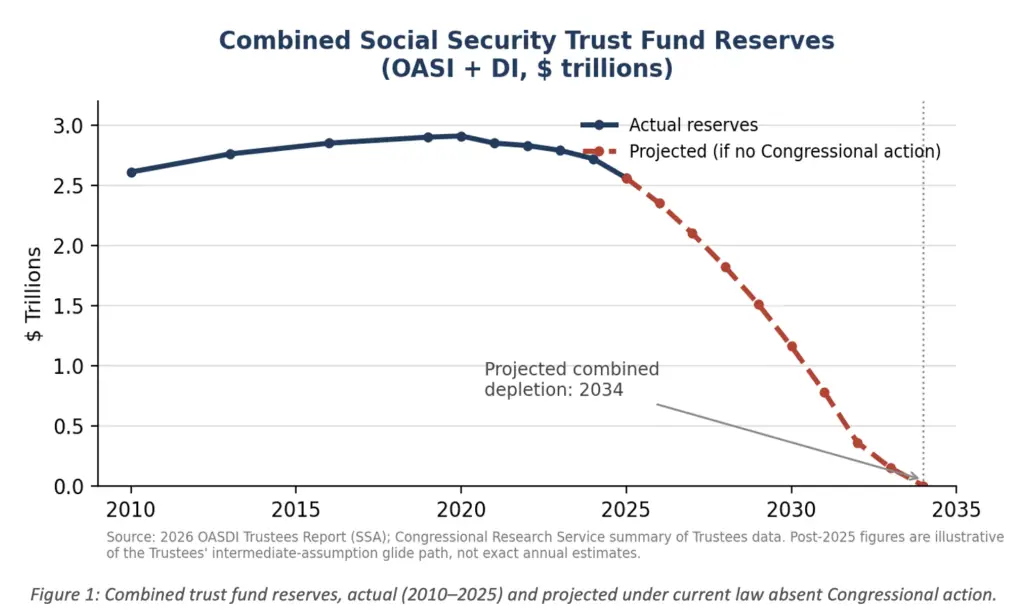
- Social Security has two trust funds: one for retirement and survivor benefits (OASI) and one for disability benefits (DI). Combined, they held about $2.56 trillion in reserves at the end of 2025.
- The OASI (retirement) fund on its own is projected to deplete its reserves in late 2032. Combined with the smaller DI fund, the depletion date moves to the third quarter of 2034.
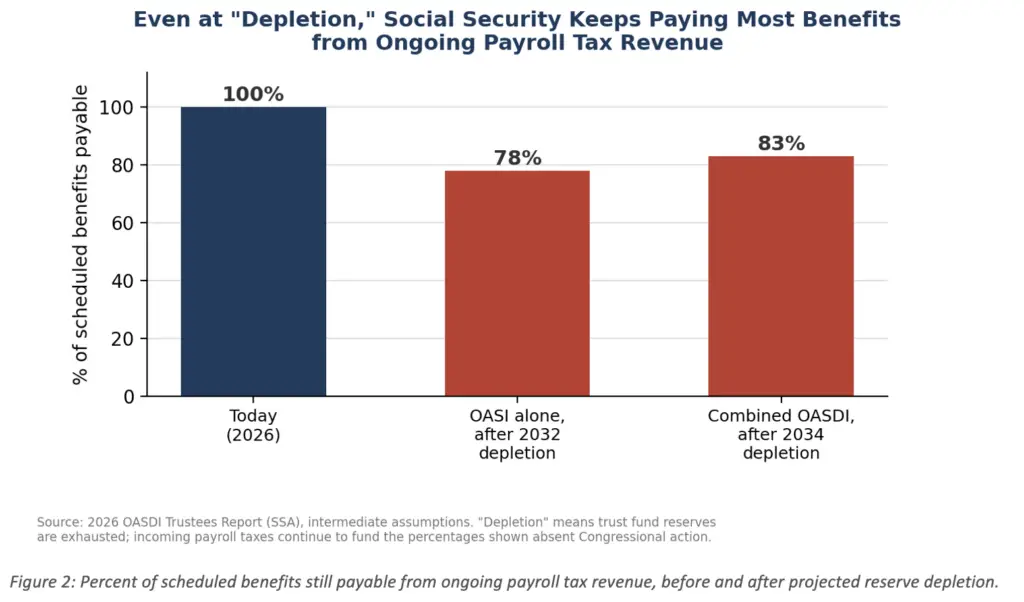
- “Depletion” does not mean $0 in benefits. It means the reserve cushion is used up. After that point, the program still collects payroll taxes from current workers, and those taxes alone are projected to cover 78% of scheduled retirement benefits (or 83% on a combined basis).
In other words, the honest headline isn’t “Social Security is running out.” It’s closer to: “If Congress does nothing between now and the early 2030s, benefits would need to be reduced by roughly 17–22%, not eliminated.” That’s a meaningfully different and more manageable problem.
Why the Program Is Under Strain in the First Place
This is demographics and math the Trustees have been flagging for decades:
- Social Security is funded primarily by a 12.4% payroll tax (split between employee and employer) on wages up to a cap, $184,500 in 2026.
- The program’s total cost has exceeded its total income since 2021, and non-interest income (payroll taxes alone) has fallen short of costs since 2010. The difference has been made up by drawing down reserves built during the 1980s–2000s, when the program ran large surpluses.
- Longer life expectancies, lower birth rates, and a wave of Baby Boomer retirements mean there are simply more beneficiaries per worker than the system was originally built around.
We’ve Been Here Before
This will not be the first time Congress has acted to shore up Social Security. In 1983, the trust fund was projected to run dry within months. Congress responded with a bipartisan package, gradually raising the full retirement age, bringing more workers into the system, and subjecting a portion of benefits to income tax, that extended solvency for decades.
Today’s menu of options looks similar in kind, even if the specifics differ. The Trustees themselves model several, including:
- Raising or eliminating the payroll tax cap on higher earners, estimated to raise roughly $3.4 trillion over ten years if the cap were eliminated with corresponding benefit credit.
- A modest, phased-in increase to the payroll tax rate, for example, moving gradually from 12.4% to 13.4% has been estimated to close roughly a quarter of the long-term funding gap on its own.
- Adjustments to the taxation of benefits, the retirement age, or the benefit formula for higher earners, all tools that have been used, in some combination, in prior reforms.
We’re not making a prediction about which combination Congress will choose, or when. What the historical record shows is that this is a solvable math problem with known levers, and lawmakers have a strong track record of acting once a deadline is close enough to force the issue.
What We’d Suggest Keeping in Mind
- No one currently receiving benefits, or close to claiming them, has ever seen a missed Social Security payment in the program’s 90-year history, including through the 1983 near-depletion.
- A benefit reduction in the high-teens to low-twenties percent range, phased in only if no legislative fix occurs by the early 2030s, is a very different planning problem than zero benefits. It’s the kind of scenario a well-built retirement income plan can flex around.
- For clients still years from claiming, this is a good reminder that Social Security is one leg of a retirement income stool — not the whole chair.
Let’s Talk
This is exactly the kind of headline-driven topic we’d rather bring to you directly than sit with on your own. If you want to see how a scenario like a 15–20% benefit adjustment down the road would affect your specific plan, or you just want to talk through what you’ve been reading, reach out any time — general question or client-specific, we’re glad to help.
Sources
Social Security Administration, “2026 Annual Report of the Board of Trustees” and SSA press release, June 9, 2026 (ssa.gov/news). Congressional Research Service, “Social Security: Selected Findings of the 2026 Annual Report,” IF13256. Bipartisan Policy Center, “2026 Social Security Trustees Report Explained,” June 2026. Center on Budget and Policy Priorities, “What the 2025 Trustees’ Report Shows About Social Security.” Peter G. Peterson Foundation, “Social Security Reform: Options to Raise Revenues.” AARP, “How Is Social Security Funded?”
Important Disclosures
Investment advisory services offered through Channel Wealth, LLC, a registered investment advisor with the U.S. Securities and Exchange Commission. This material is intended for informational purposes only. It should not be construed as legal or tax advice and is not intended to replace the advice of a qualified attorney or tax advisor. The information contained may have been compiled from third-party sources and is believed to be reliable as of the date of this email. Social Security projections are estimates based on current law and are subject to change. Please contact us directly to discuss how this information applies to your personal situation.
Investing involves risk, including the possible loss of principal. Past performance is no guarantee of future results.
Channel Wealth and advisors do not provide legal, tax or accounting advice. Clients should consult their legal and/or tax advisors before making any financial decisions.
This information should not be construed as investment advice and is subject to change. It is provided for informational purposes only and is not intended to be either a specific offer by Channel Wealth or any affiliate to sell or provide, or a specific invitation for a consumer to apply for, any particular retail financial product or service that may be available.
All recommendations must be considered in the context of an individual investor’s goals, time horizon, liquidity needs and risk tolerance. Not all recommendations will be in the best interest of all investors.
© 2026 Channel Wealth LLC,. All rights reserved