
Market Recap
Investors’ patience was put to the test in the first half of 2026. An unsettling few months were caused by a dramatic spring selloff, a flare-up in the Middle East, and no shortage of debate over whether spending on artificial intelligence has gone too far. Despite this, stocks and high-quality bonds both ended the period in good shape. In this letter, we want to walk through what happened, why it happened, and ultimately why we continue to believe a thoughtful, actively managed approach is the right one for navigating what comes next.
Businesses are still hiring, though at a slower pace than a couple of years ago, and companies continue to invest heavily in the infrastructure behind artificial intelligence: chips, data centers, and the power to run them. That spending is showing up in company profits, and rising portfolios have made many households feel wealthier and more willing to spend. However, this year, the cost of living has been an irritant to markets. Tensions in the Middle East pushed energy prices higher, which fed through to inflation and kept the Federal Reserve from cutting interest rates as quickly as hoped. Borrowing costs remain a burden for the housing market and for households on tighter budgets.
To keep an outside perspective on how the economy is doing, without fixating on headlines, we track a broad dashboard of the indicators that have reliably flagged past downturns: hiring trends, consumer confidence, factory orders, credit conditions, and more. You can see the current indicators below as well as the indicators during previous downturns.
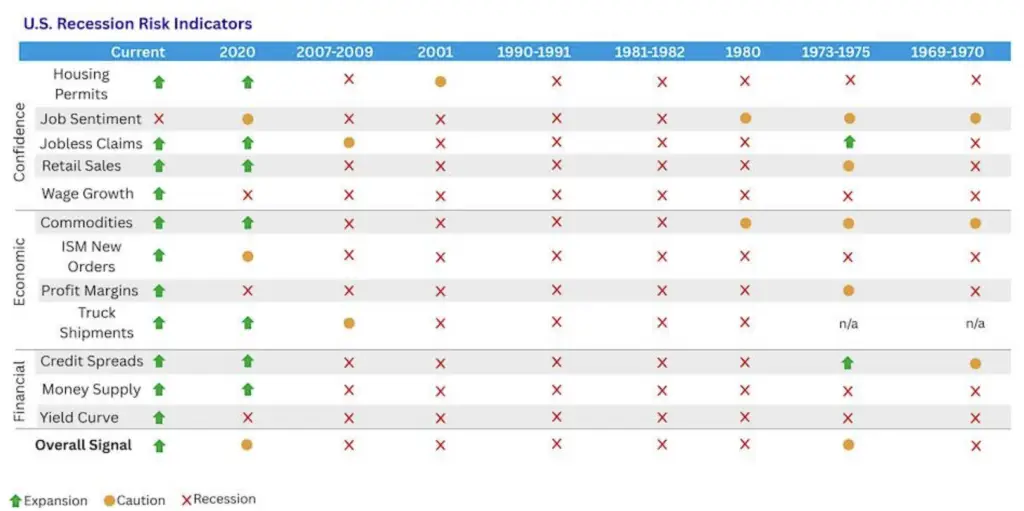
The overwhelming majority of signals currently point toward continued growth (green) rather than caution (yellow) or outright recession risk (red), demonstrating a meaningfully healthier picture than we saw heading into past downturns.
The rebound from the spring low was forceful, and the advance for the year overall has been a healthy one by historical standards. Much of the market increase belongs to a small handful of technology companies that are building the infrastructure behind artificial intelligence. Although it is worth celebrating, it is also worth watching closely, because when so much of the market performance rests on so few companies, the whole market becomes more exposed to whatever happens to those companies next.
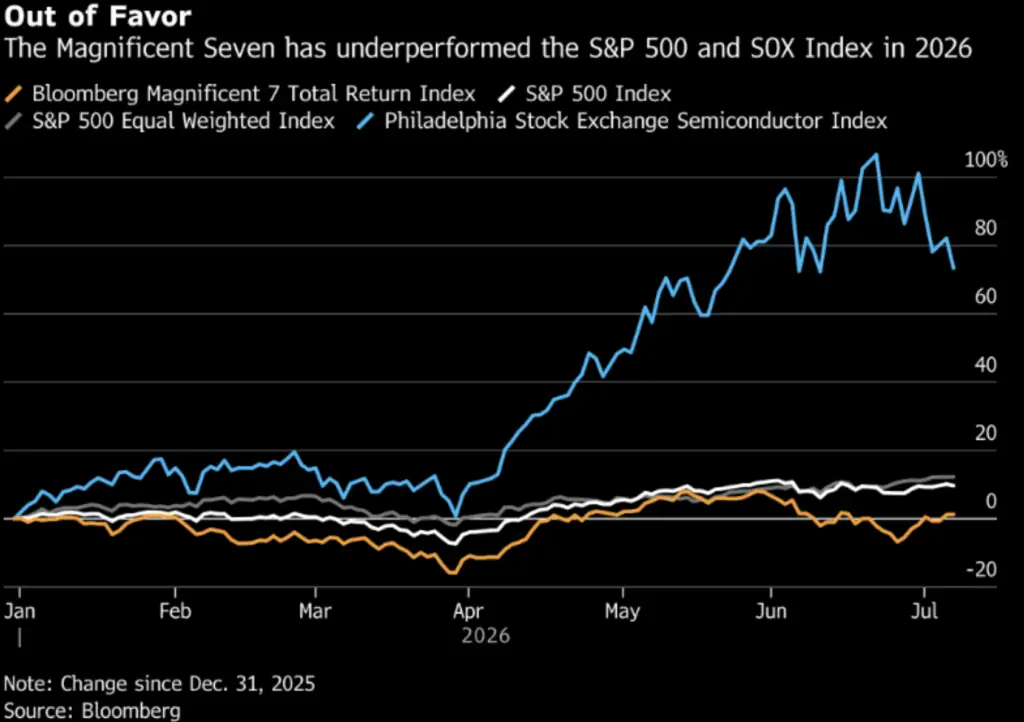
As a matter of fact, this small group of AI-related giants, often nicknamed the “Magnificent Seven,” cooled off and lagged the broader market over the second quarter, even as the overall market and the semiconductor industry kept climbing. The Magnificent Seven are the companies using their massive earnings to build the AI data centers that are driving markets higher. Essentially, the chip companies’ breathtaking margins are coming at the expense of the Magnificent Seven, and the markets have priced it accordingly. See the blue line compared to the orange line above.
Meanwhile, steadier, less glamorous corners of the market have quietly started to take the lead. We view this kind of rotation as healthy. It is a reminder that enthusiasm begins to broaden beyond a handful of household names, and it is exactly the environment in which careful, research-driven company selection tends to matter most.
The Bigger Picture
This circumstance has occurred before; markets have always displayed moments when leadership narrows around one compelling idea about the future. In 1980, energy companies made nearly a third of the S&P 500; today they are a small fraction of it. At the peak of Japan’s boom in the late 1980s, Japanese stocks were the largest weight in world equity indexes; today they are a small fraction of that too. These episodes are not perfect parallels to today, and concentration alone is not a signal to sell. But history is consistent on one point: the leaders of one era are rarely the leaders of the next.
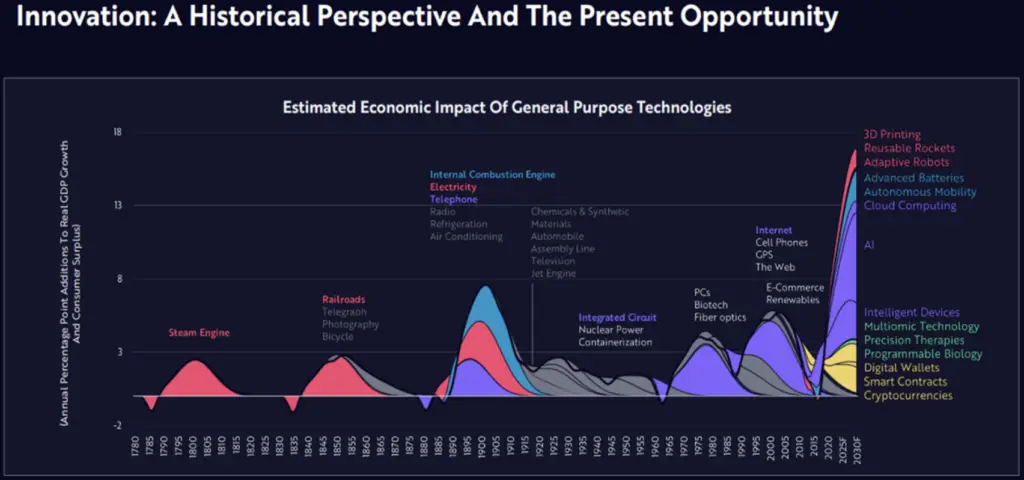
This chart puts today’s artificial intelligence boom into historical context. Since the late 1700s, a series of transformative, general-purpose technologies, like the steam engine, railroads, electricity, the internal combustion engine, the integrated circuit, and the internet, have fueled a wave of economic growth, then eventually given way to the next big idea. Artificial intelligence appears to be following a similar arc, and quite possibly a larger one. The lesson we take from this history is not to avoid the standout theme, but to avoid betting everything on it, since no single technology, no matter how transformative, has ever been the last word.
An index doesn’t have judgement. It does not ask whether a business is strengthening or weakening, whether a hot new industry has become overvalued, or whether a handful of companies have grown so large that they now dictate the index risk almost single-handedly. Index investors, by design, take on whatever concentration the market hands them, with no mechanism to manage it.
Our approach is different. We aim to hold outstanding businesses genuinely benefiting from this technological cycle, sized appropriately rather than at whatever weight the market has assigned them, while also making room for well-run, attractively priced companies across different industries and around the world that may be overlooked. Bonds continue to play their traditional role of ballast, providing steady income and helping cushion portfolios when stocks wobble. Our goal is not to predict the next twist in this cycle but to build portfolios resilient enough to do well across a range of outcomes.
What This Means for You
Markets will always give us something to worry about; today it is energy prices, interest rates, and whether spending on artificial intelligence can keep paying off at its current pace. Our job is not to eliminate every bump along the road, but to make sure your portfolio is built to handle them, so that short-term noise does not derail your long-term goals. That means staying invested and diversified, while continuing to lean on research and judgment rather than simply following the crowd, and revisiting your allocation periodically to make sure it still matches your goals, time horizon, and comfort with risk.
As always, we would be happy to discuss how these themes precisely relate to your goals and portfolio. Please do not hesitate to reach out to your advisor with any questions.
Sources
- BLS, Federal Reserve, Census Bureau, ISM, BEA, American Chemistry Council, American Trucking Association, Conference Board, Bloomberg, CME, FactSet and Macrobond
- Bloomberg
- https://boardsimpactforum.com/2024/02/01/ai-and-innovation-is-set-to-skyrocket-market-value-transform-industries-and-impact-sustainability/
Index Definitions
Securities indexes assume reinvestment of all distributions and interest payments. Indexes are unmanaged and do not take into account fees or expenses. It is not possible to invest directly in an index. Indexes are all based in U.S. dollars. S&P 500 Index is a stock market index tracking the stock performance of 500 of the largest companies listed on stock exchanges in the United States.
Chicago National Activity Index is a monthly index designed to gauge overall economic activity and related inflationary pressure. University of Michigan’s Consumer Sentiment Index is a consumer confidence index published monthly by the University of Michigan. Nasdaq is an online global marketplace for buying and trading securities. New York Stock Exchange is a stock exchange where the equity shares of public companies are bought and sold.
Important Disclosures
Investing involves risk, including the possible loss of principal. Past performance is no guarantee of future results.
Channel Wealth and advisors do not provide legal, tax or accounting advice. Clients should consult their legal and/or tax advisors before making any financial decisions.
This information should not be construed as investment advice and is subject to change. It is provided for informational purposes only and is not intended to be either a specific offer by Channel Wealth or any affiliate to sell or provide, or a specific invitation for a consumer to apply for, any particular retail financial product or service that may be available.
All recommendations must be considered in the context of an individual investor’s goals, time horizon, liquidity needs and risk tolerance. Not all recommendations will be in the best interest of all investors.
Asset allocation, diversification and rebalancing do not ensure a profit or protect against loss in declining markets.
Investments have varying degrees of risk. Some of the risks involved with equity securities include the possibility that the value of the stocks may fluctuate in response to events specific to the companies or markets, as well as economic, political or social events in the U.S. or abroad. Investing in fixed-income securities may involve certain risks, including the credit quality of individual issuers, possible prepayments, market or economic developments and yields and share price fluctuations due to changes in interest rates. When interest rates go up, bond prices typically drop, and vice versa. Bonds are subject to interest rate, inflation and credit risks. Investments in high-yield bonds (sometimes referred to as “junk bonds”) offer the potential for high current income and attractive total return, but involves certain risks. Changes in economic conditions or other circumstances may adversely affect a junk bond issuer’s ability to make principal and interest payments. Treasury bills are less volatile than longer-term fixed income securities and are guaranteed as to timely payment of principal and interest by the U.S. government. Investments in foreign securities (including ADRs) involve special risks, including foreign currency risk and the possibility of substantial volatility due to adverse political, economic or other developments. These risks are magnified for investments made in emerging markets. Investments in a certain industry or sector may pose additional risk due to lack of diversification and sector concentration. Investments in real estate securities can be subject to fluctuations in the value of the underlying properties, the effect of economic conditions on real estate values, changes in interest rates, and risk related to renting properties, such as rental defaults Alternative investments are speculative and involve a high degree of risk.
Alternative investments are intended for qualified investors only. Alternative Investments such as derivatives, hedge funds, private equity funds, and funds of funds can result in higher return potential but also higher loss potential. Changes in economic conditions or other circumstances may adversely affect your investments. Before you invest in alternative investments, you should consider your overall financial situation, how much money you have to invest, your need for liquidity, and your tolerance for risk.
Nonfinancial assets, such as closely held businesses, real estate, fine art, oil, gas and mineral properties, and timber, farm and ranch land, are complex in nature and involve risks including total loss of value. Special risk considerations include natural events (for example, earthquakes or fires), complex tax considerations, and lack of liquidity. Nonfinancial assets are not in the best interest of all investors. Always consult with your independent attorney, tax advisor, investment manager, and insurance agent for final recommendations and before changing or implementing any financial, tax, or estate planning strategy.