
Executive Summary
As we wrap up the third quarter of 2026, the big headlines for the year are coming into focus: 1) Corporate America is hitting on all cylinders. 2) Global Gov’t Interest rates are at the highest levels since 2007.
Corporate America is seeing the strongest earnings acceleration since the 2021 post-pandemic rebound, with full-year S&P 500 earnings growth running north of 15%. Through the close of Q3 on September 30th, the S&P 500 is up 12.73% year-to-date and 2.3% for the quarter1.
Over the past few years, stock gains were driven mostly by multiple expansion—people simply paying more for every dollar of earnings. Today, underlying fundamentals have caught up. Massive investments in AI infrastructure, widening corporate margins, and resilient U.S. economic growth have pushed S&P 500 profitability to some of the highest levels in modern history.
We believe we are in the middle of a generational technology buildout on par with the 19th-century railroads or the late-1990s internet boom. This isn’t just software code—it is physical, power-hungry infrastructure spanning data centers, grid overhauls, domestic chip manufacturing, and factory automation.
That said, strong earnings do not mean smooth sailing. Lingering geopolitical risks, sharp oil price swings, and a relentless climb in bond yields have introduced real crosscurrents. The 10-year U.S. Treasury yield recently pushed through 5.3%, leaving the broad US bond index4 performance at -2.91% year-to-date and -3.51% for the third quarter.
In this issue, we list the key themes and outlooks shaping our portfolios and the markets today.
Theme #1: Higher Interest Rates & The Fed’s New Move
Late-summer volatility kicked off as headline inflation settled around 3.7%—well above the Fed’s 2% goal.
After a split meeting in July and a hawkish tone at Jackson Hole from Fed Chair Kevin Warsh, expectations flipped quickly from rate cuts to rate hikes. On September 16th, the Fed unanimously raised rates by 25 basis points to a target range of 3.75%–4.00%.
Interest rates are facing intense pressure from both sides of the ledger:
- The Supply Squeeze: Persistent geopolitical instability, shifting energy dynamics, and acute shortages of grid and power equipment continue to hold high input costs. These real-world bottlenecks prevent inflation from normalizing cleanly.
- The Demand Squeeze: Massive corporate bond issuance—driven by generational power and technology buildouts—is actively competing for market liquidity alongside annual U.S. Treasury deficits approaching $2 trillion.
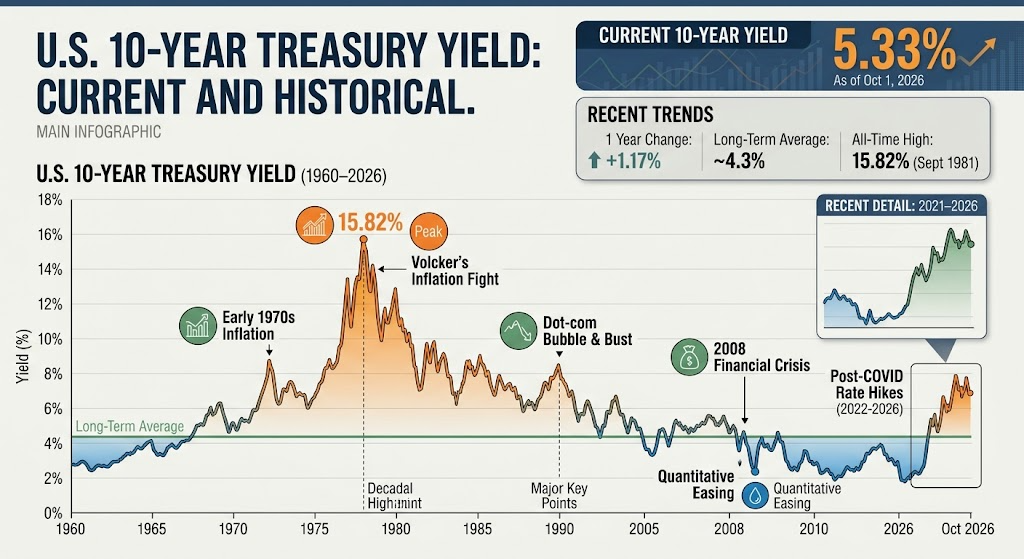
Source: US Dept of Treasury, Federal Reserve.
Our view: Higher rates raise the bar for equities that self-fund from those that rely on continuous debt refinancing. Smaller economically sensitive companies typically operate with narrower gross margins and less pricing power. We continue to position portfolios around companies with distinct competitive moats, pricing power to defend margins against sticky input costs, low debt-to-capital ratios, and the internal cash flow necessary to fund their own expansion without relying on external financing.
Theme #2: The AI Buildout: “Show Me the Return”
Artificial intelligence remains the market’s primary engine, but Wall Street is asking tougher questions. Big tech hyperscalers (Microsoft, Amazon, Google, Meta, Oracle) are on track to spend roughly $950 billion on AI infrastructure this year. Investors are now watching closely to see when that massive cash outlay will show up as durable revenues in the future.
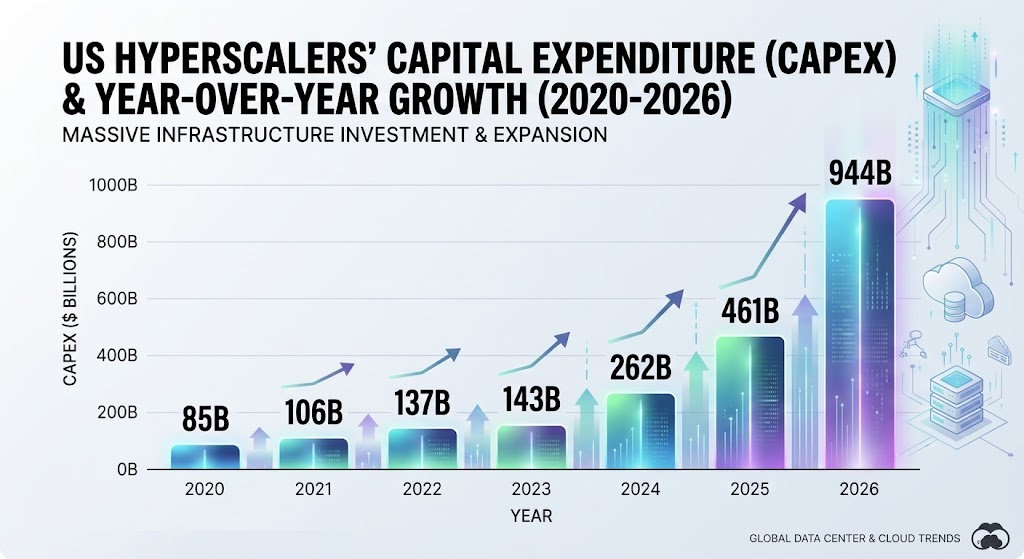
Source: UBS Hyperscaler Spending Tracker: Microsoft, Amazon, Alphabet, Meta, and Oracle
Our view: Artificial intelligence may prove to be one of the most consequential technologies of our generation. However, a large portion of the market has become tied to the same underlying growth driver: AI capital spending. We believe this creates a concentration risk. Our view is to be selective and careful about the exposure we have to these AI themes. Distinguishing between investments whose fortunes depend primarily on continued AI infrastructure build-out versus those positioned to benefit from the broader economic growth that AI provides.
Theme #3: The Shifting Business Cycle – Atypical
When comparing current economic metrics: economic growth, labor market, monetary policy, credit conditions, versus history, it tells us we are in the mid to later stages of this business cycle. Corporate capex spending and fiscal government spending is creating an atypical reading.
The chart below maps the key macro metrics into the current economic cycle.
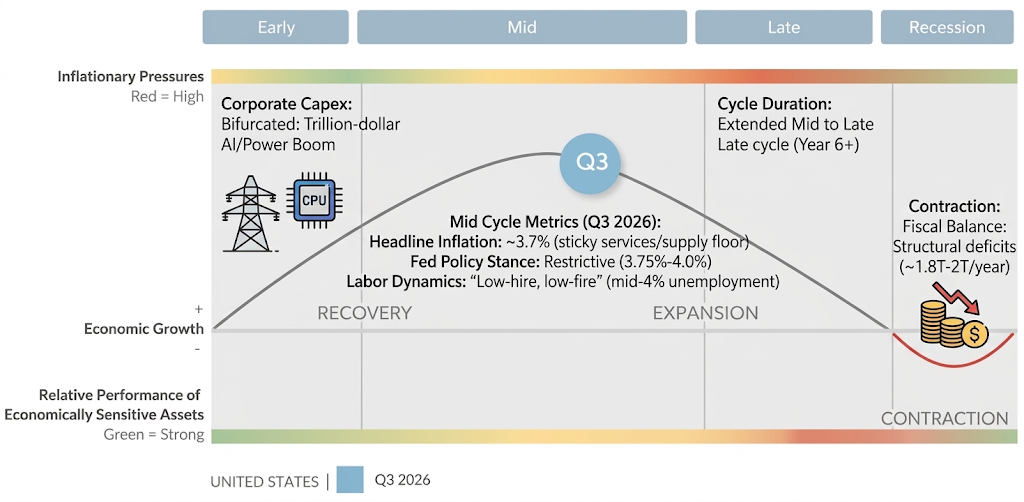
Source: Fidelity, Channel Wealth, Google. (2006) Gemini (Advanced version, LLM)
The Takeaway: As the current business cycle enters mid to late stage, we prefer to move up in quality with our investments. We like equities that operate with lower debt leverage and strong profitability, for example the healthcare sector. We like fixed income that preserves capital, with investment grade ratings and medium length maturities. We like real assets and alternatives that create uncorrelated moves to equity and bond markets, for example critical infrastructure power assets and gold.
Theme #4 – Deficits & The Midterm Horizon
Washington’s fiscal footprint continues to shape investment opinions:
- Treasury Supply Overhang: Massive federal budget deficits mean the Treasury must issue large volumes of debt, keeping upward pressure on long-term bond yields.
- Policy & Tax Watch: Markets are beginning to handicap the upcoming midterm elections, weighing the odds of legislative gridlock, defense and energy spending shifts, and the looming expiration dates of key tax cuts.
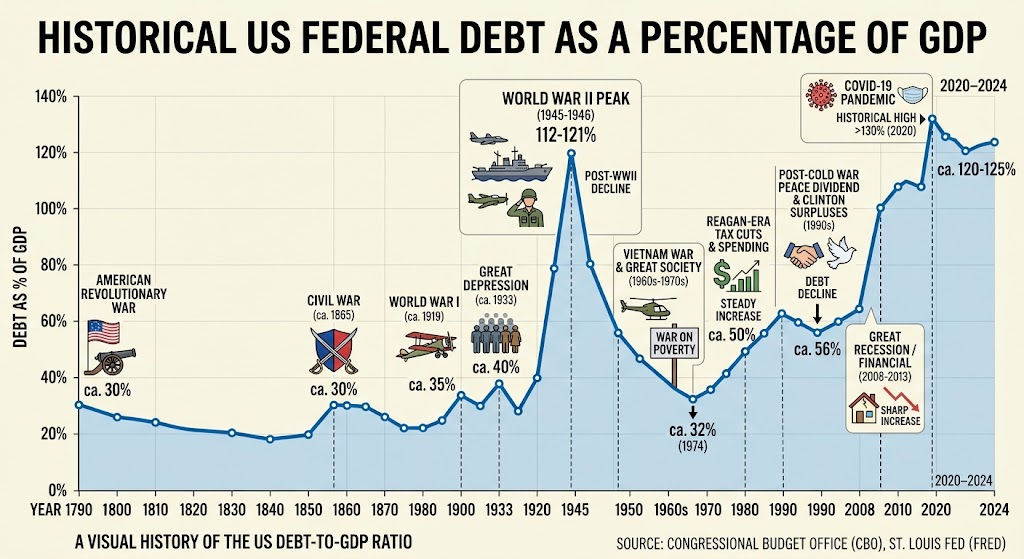
Our view: U.S. government debt just surpassed $40 trillion, having more than doubled in less than a decade. Debt held by the public stands at roughly 120% of gross domestic product (GDP). Most importantly, the U.S. consumer and corporate sectors remain in healthy shape.
Mid-Term Elections
Historically, markets have performed remarkably well during periods of government gridlock (a divided Congress or a president facing an opposing legislature), often matching or exceeding the returns seen during unified governments, see the chart below.
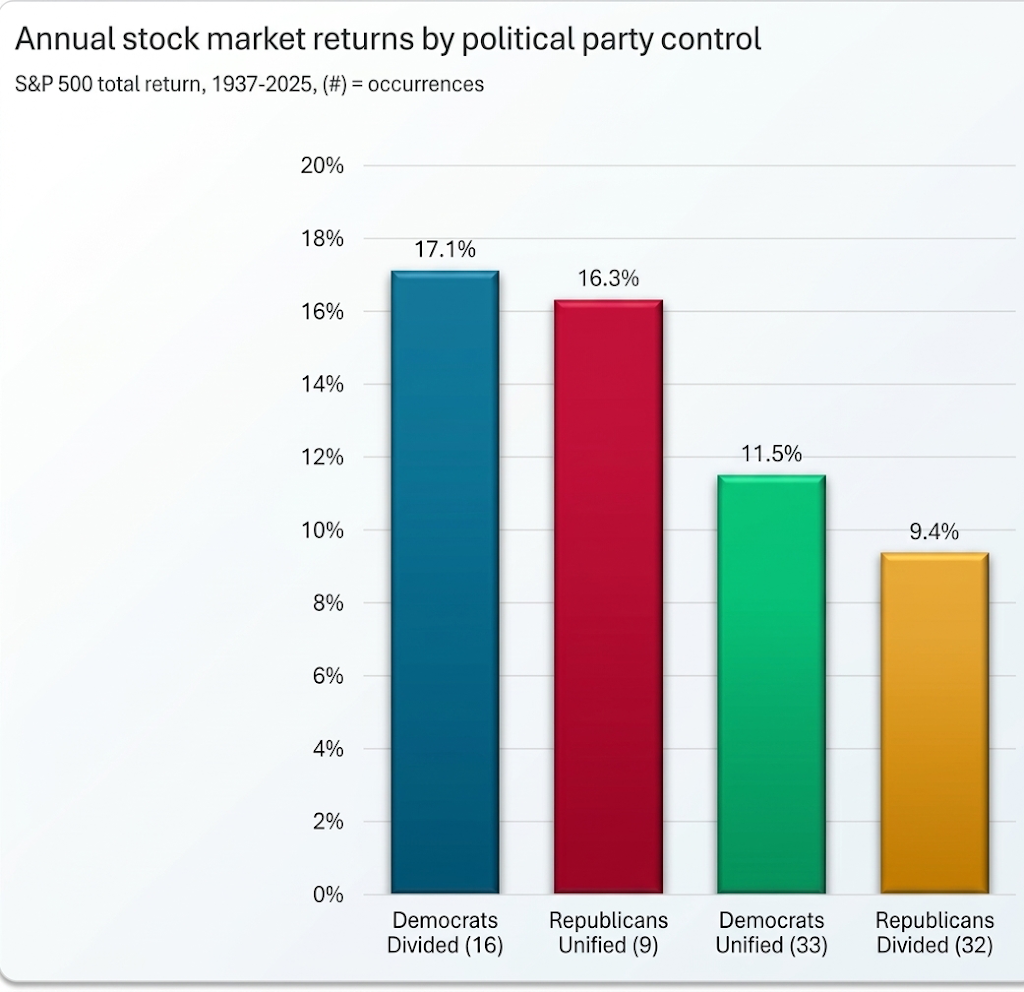
Source: JPMorgan
The broader takeaway is that while political rhetoric peaks around midterms, strong corporate earnings and economic fundamentals appear to be the main factors driving short term market returns. Government gridlock primarily serves to keep Washington from getting in the way of that fundamental momentum.
Our Year-End Strategy
Our strategy centers on balance, quality, and investing around structural themes that drive today’s global economy:
- Focusing on Quality Equities: Continue to have positive view on exposure to AI momentum themes but anchor the portfolio with businesses that generate real cash, enjoy pricing power, and have strong balance sheets that don’t depend on low interest rates and AI momentum. We see brighter relative growth & valuation trends in emerging markets and some developed international markets like Japan and UK.
- Locking In Bond Yields: With benchmark yields hovering around 5%, we are looking towards intermediate bonds and high-grade municipal debt to capture strong, predictable income without taking unnecessary long-term price risk.
- Patience & Discipline: Market volatility is a feature of late-cycle expansions, not a bug. Pullbacks provide welcome opportunities to put capital to work in durable, cash-generative leaders at better valuations.
As always, please reach out if you’d like to review your allocation or discuss how these moves fit into your broader plan. Thank you for your continued partnership and trust.