
A potential SpaceX IPO has drawn considerable attention across institutional and retail markets. Before assessing the opportunity, we think it is worth examining what historical data tells us about IPO performance, current valuation metrics, and the structural dynamics that have historically followed large public offerings.
IPO Performance: What the Data Shows
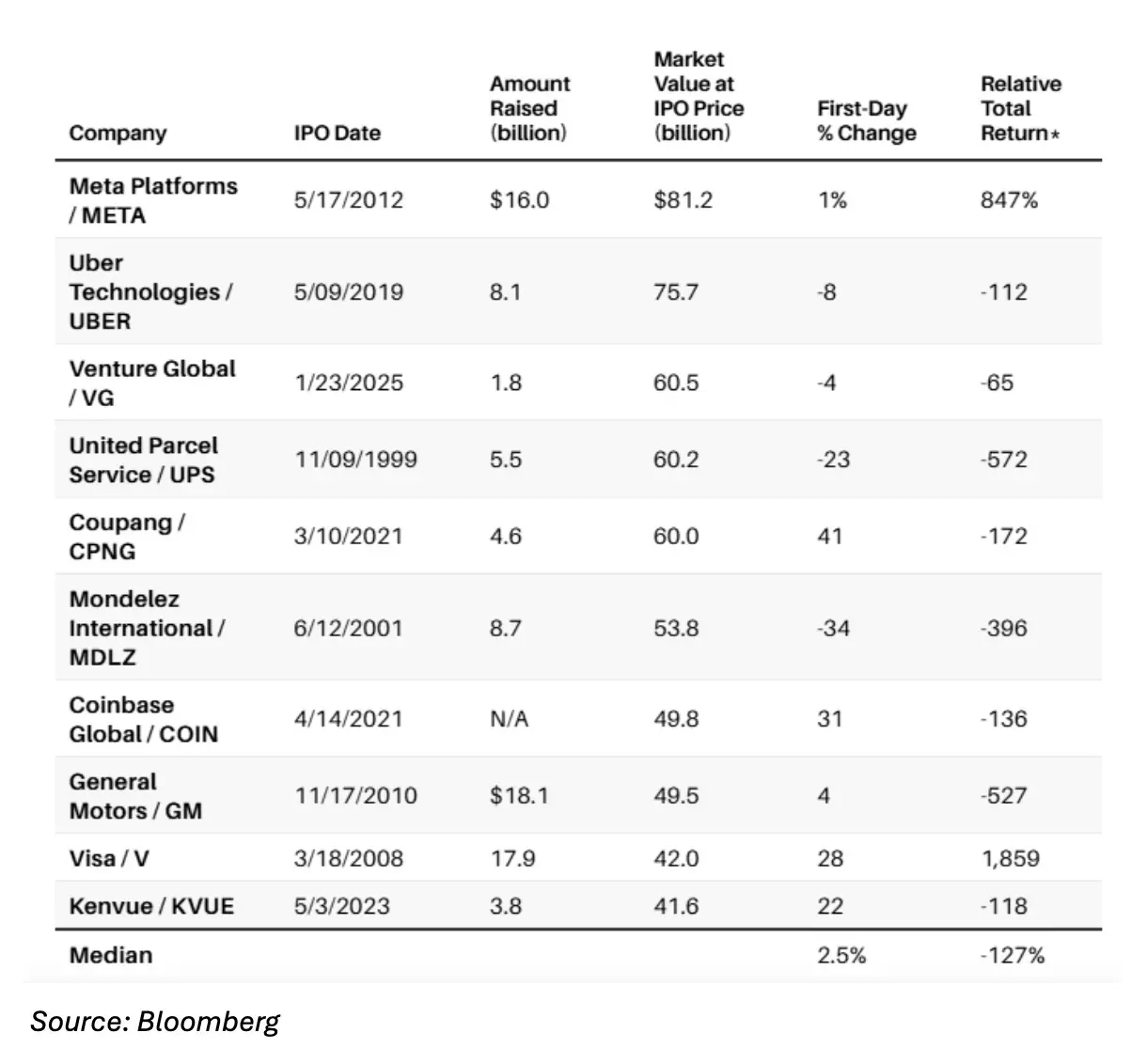
In general, large IPOs have historically produced strong first-day returns that have not been sustained over time. Of the 1,724 U.S. IPOs from 2011 through 2024, the average stock gained 23% on its opening day. Over the subsequent three years, those same stocks underperformed the S&P 500 by an average of 25 percentage points, according to data from Jay Ritter, a finance professor at the University of Florida who has studied IPO performance extensively.
This pattern is most pronounced among the largest offerings. IPOs valued above $15 billion tend to see amplified first-day appreciation, followed by a more extended period of underperformance relative to the broader market.
Valuation
SpaceX is currently trading in private markets at approximately 93 times trailing sales. Historical data on IPOs priced above 40 times sales, going back to 1980, shows an average three-year return of -45%.¹ At 93 times trailing sales, SpaceX enters well above that threshold.
The Lock-Up Period
Standard IPO structure typically includes a six-month lock-up period during which early and pre-IPO investors are restricted from selling shares. SpaceX has a substantial base of long-term private investors. Upon expiration of the lock-up, an increase in selling activity is typical, which has historically created additional downward pressure on share prices in the months that follow. The time to buy would appear to be after this 6-month lock up.
IPOs That Worked
However, there have been IPOs that paid off. Visa, the global payment technology company, went public in 2008 and has a total return of 631%. Visa’s IPO itself was remarkable for its timing and structure, their dominant network effect and ability to penetrate the cash to card payment market proved successful, delivering a 19.3% Compound Annual Growth Rate (CAGR)² since its IPO.
META, which operates the largest social media and messaging platforms (Instagram, Facebook, Messenger, etc.), went public in 2012 and has a total return of 1,797%. While the first couple months for META’s IPO was rocky, their lack of competition and addition of advertisements built the networking giant we know today.
Both companies shared key traits that explain their long-term performance: dominant network effects, asset-light business models, massive secular tailwind, and first-mover advantage.
The Long-Term Opportunity
SpaceX’s total addressable market³ is estimated at approximately $27 trillion. The long-term growth thesis centers on a potential expansion beyond aerospace and launch services into AI infrastructure, specifically, the use of its satellite network as a backbone for enterprise AI workloads in lieu of traditional data centers.
The current valuation appears to reflect this potential. However, the underlying business model depends on a market segment that remains nascent. After a company’s first earnings call as a public entity, the market typically develops a more precise view on the timeline and probability of execution, which has historically been a catalyst for multiple compression in high-growth, high-valuation IPOs.
Footnotes:
¹ Jay R. Ritter, “The Market’s Problems with the Pricing of Initial Public Offerings,” Journal of Applied Corporate Finance (1994): 66–74.
² The Compound Annual Growth Rate (CAGR) is the annual rate of return that shows how an investment grows from its beginning value to its ending value over time, assuming reinvested profits.
³ Total Addressable Market measures the maximum potential revenue a company could generate from a product or service within a specific market, assuming no competitive or operational constraints. It is a theoretical concept used to assess market size, prioritize business opportunities, and guide investment decisions.
Disclaimer: Investment advisory services offered through Channel Wealth, LLC, (“Channel”), a Registered Investment Advisor with the U.S. Securities and Exchange Commission. Registration does not imply any level of skill or training. The content provided is for informational and educational purposes only and does not constitute investment, legal, or tax advice. Investments, including Initial public offerings (IPO), carry risks, including the potential loss of principal. Past performance is not indicative of future results. Before making any financial decisions, you should consult with your personal financial, legal, or tax advisor to evaluate your individual circumstances. Channel does not guarantee the accuracy, completeness, or timeliness of the information presented, and it may be subject to change without notice. Diversification does not guarantee a profit or protect against loss in declining markets. Investment products are not FDIC insured, not bank guaranteed, and may lose value. This material, or any portion thereof, may not be reprinted, sold, or redistributed without the written consent of Channel Wealth, LLC.
Any positive effect of investments in IPOs may not be sustainable because of a number of factors. For example, investors may not be able to buy shares in some IPOs, or may be able to buy only a small number of shares. Also, the performance of IPOs generally is volatile, and is dependent on market psychology and economic conditions. To the extent that IPOs have a significant positive impact on an investor’s performance, this may not be able to be replicated in the future.